
RESEARCH
11/6/2025 | 10 min
Why Faceless Content Is Winning: When "Content" Matters More Than "Persona"
97% of creators in a new poll choose faceless video. Data shows why AI voices, avatars, and systems now outperform on-camera charisma.
If you asked a content creator five years ago for their secret to success, the answer would likely be "personal charisma," "on-camera presence," and "emotional connection with the audience."
But today, choices from our creator community are telling a completely different story.
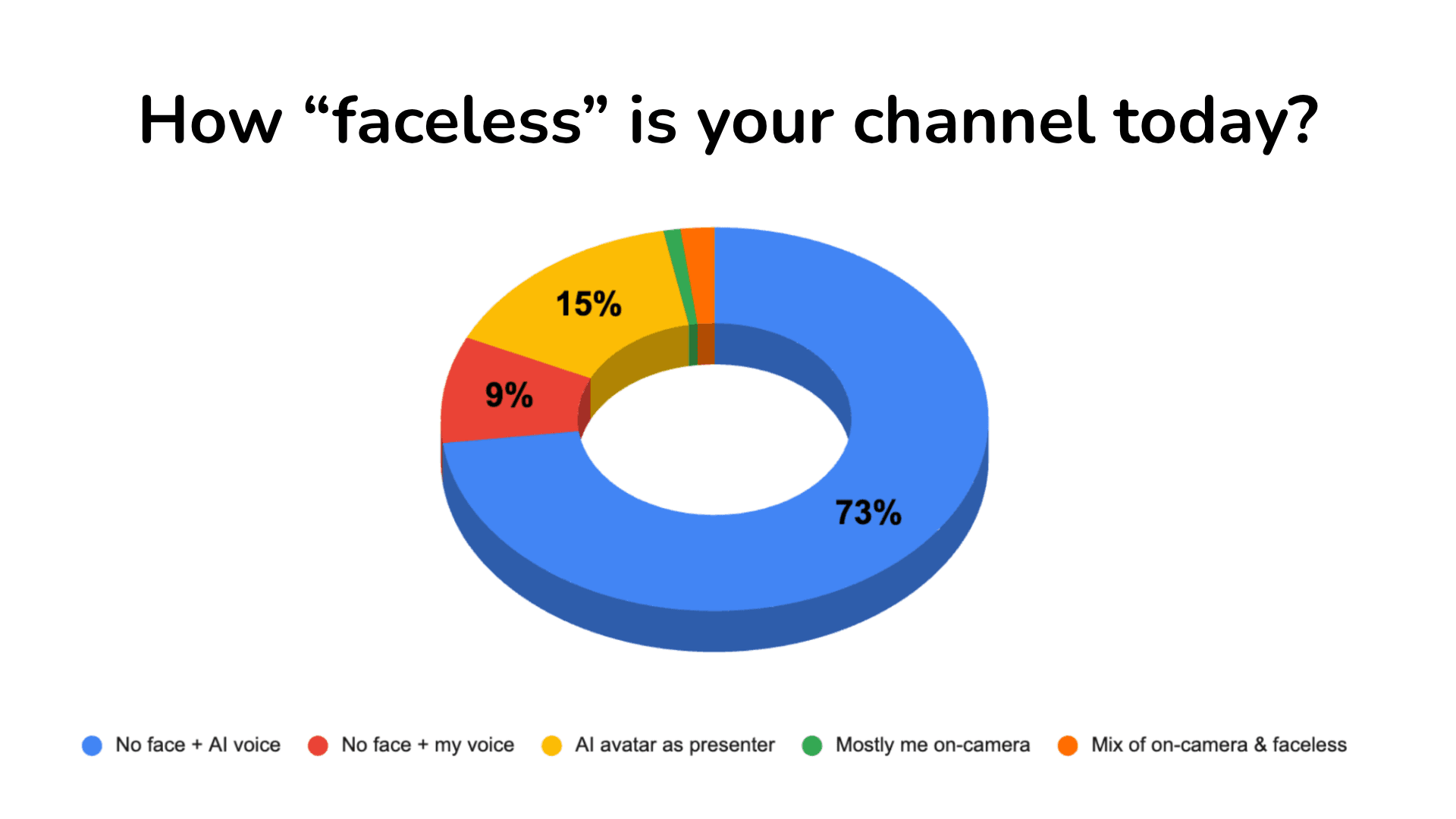
How “faceless” is your channel today?
- No face + AI voice - 73%
- No face + my voice - 9%
- AI avatar as presenter - 15%
- Mostly me on-camera - 1%
- Mix of on-camera & faceless - 2%
The rise of AI video creation has fundamentally changed what's possible. This recent creator survey from our community reveals just how strong the trend towards faceless video is.
The data reveals two overwhelming facts:
- 97% of Crreo creators choose to be "faceless" or use an AI avatar;
- Among them, 73% have chosen the ultimate "faceless" mode of "No face + AI voice."
While this reflects our creator community of ‘AI-first’ creators, the trend mirrors what we're seeing across YouTube and TikTok, where faceless videos are gaining very strong traction.
What is a faceless channel
A 'faceless channel' is one where the creator does not appear on camera.Its core difference is its focus on delivering in-depth content—such as in a documentary or educational style—rather than building content around a creator's personal brand.
To produce these videos, creators rely on visuals such as AI-generated footage, stock footage, screen recordings, or animations, paired with AI-generated or human voiceovers.
Why is "faceless" creation no longer a niche field, but a trend that has already arrived?
1. Business Considerations: Unmatched Advantages in Efficiency and Cost
Why do 73% of people not only "not show their face," but even give up their "own voice"?
The answer is business efficiency. From the perspective of operating "Cash Cow Channels," the "faceless" model has overwhelming advantages:
Extremely low startup costs: You don't need to buy expensive cameras, lighting, microphones, or set up a studio. A computer and the right AI tools are enough.
Extremely high production efficiency: Creators save a massive amount of time—no need for makeup, staging, or repeated recordings due to mistakes or poor expressions.
Sustainable, industrialized production: Continuous on-camera appearances are emotionally and mentally draining for creators. The "automated" (faceless) model allows creators to "industrialize" the production process, preventing personal fluctuations from affecting the frequency and quality of content output.
2. The Creator's "Psychological Safety": Avoiding On-Camera Anxiety and Online Risks
For many creators, avoiding the psychological pressure and privacy risks of "becoming a public figure" is also a key motivator.
"Faceless" creation helps them eliminate camera shyness, anxiety about appearance, and self-consciousness about accents, while also avoiding cyberbullying, doxxing, and offline harassment.
This "psychological shield" allows them to focus more on the content itself.
3. Why Faceless Content Is Winning: When "Content" Matters More Than "Persona"
The rise of faceless creation isn't just a choice by creators to improve efficiency, lower costs, and reduce psychological burdens; it's also a trend propelled by the twin forces of shifting audience attention and algorithmic distribution.
4. The Shift in Audience Attention: Content Finally Becomes the "Product"
Today, audiences are increasingly overwhelmed by a massive flow of information, leading them to become more pragmatic and efficient. They are beginning to actively "filter out" superficial forms and personas, focusing their attention on the one question that truly matters: "Does this content actually have value?"
As audience attention shifts from the "person" to the "content," technological advancements have further amplified this trend. The proliferation of AI and new creative tools has made content production simpler and more efficient than ever before.
This empowers individuals who have knowledge, opinions, or stories—but who are not skilled at or willing to appear on camera—to create work that possesses both professionalism and depth. This is a stark contrast to the traditional influencer model where "the person is the brand." More people are now able to focus purely on the content, rather than on managing an image or building a persona. For this very reason, "faceless" content is rapidly gaining popularity.
As audiences increasingly return to the content itself, and as technology makes creation more accessible, content is finally becoming the true product—no longer just an accessory to the creator's image.
5. The Algorithm Reveals the Rules: Content Relevance Is Overtaking Follower Count
Platform data and creator experience also point to a clear trend: a video's success is becoming more dependent on the appeal of the content itself, rather than just the number of followers a creator has amassed.
YouTube CEO Neal Mohan has noted that over 70% of watch time on the platform comes from AI recommendations, which means the majority of viewing behavior is "passively" matched by the algorithm, not "actively" sourced from a user's subscriptions.
TikTok has also officially stated that it does not give creators a boost simply based on their past "track record." An account with a high follower count and previous viral videos does not receive "preferential ranking" in the recommendation system over a smaller account with more relevant content.
This mechanism is clearly confirmed by actual data. A TikTok benchmark report from RivalIQ, analyzing "views per 100 followers," found a counter-intuitive phenomenon: as an account's total follower count grows, the average number of views per follower actually decreases.
Under today's algorithmic model, the era of relying on a "persona" halo and subscriber base to drive traffic is gradually passing. Platforms now encourage the discovery of new content. Therefore, for creators, consistent publishing, content relevance, and the potential for virality are the core engines driving views.
From Personal Charisma to Systemic Capability: A New Competitive Barrier Is Forming
In the past, audiences followed a creator's face and personality. Trust came from individual charisma.
As more creators choose faceless formats, we're seeing a shift in how competitive advantage is built. Rather than replacing personality, faceless creation reveals that system design is equally critical.
"System design" is reflected in whether a creator can establish an automated production chain, build standardized processes, and find their own content production engine.
This is precisely the trend we are seeing in the Crreo community. More and more creators are building their own "content production systems."
Creator Usman from our community used only a mobile phone and Crreo's Video Maker to grow from 0 to 54,000 TikTok followers in 8 months. By automating script generation and visual generation, he made his entire creation process as efficient and stable as an assembly line, with one video surpassing 1.7 million views.
Another Crreo creator, Eduardo, focuses on Spanish-language faith-based content and used Crreo's Video Maker to build a complete automated workflow. In 6 months, he gained nearly 3,000 subscribers and 4,000 watch hours on YouTube, achieving continuous, compounding growth.
They are all consistently monetizing, and their success proves a core logic:
Charisma makes you liked quickly; system design makes you grow sustainably. While faceless creators compete in a higher-volume market, they're not replacing on-camera creators—they're operating in a different playbook.
In an era dominated by algorithms and defined by "content is king," the new competitive barrier for creators is the ability to build a system that can sustainably and efficiently produce high-quality content.